
A potential customer visits your website at 10:30 PM. They ask a question, download your brochure, and leave without contacting your sales team.
The next morning, your team manually checks the lead, sends an email, follows up, and tries to understand whether the person is actually interested.
Now imagine an AI-powered marketing system doing much of this automatically.
It can identify the visitor, understand their behavior, personalize the message, send a follow-up, score the lead, and help your team decide who should be contacted first.
That is the power of AI marketing automation.
AI is changing the way businesses attract customers, communicate with audiences, create content, manage leads, and optimize advertising campaigns. But AI is not simply about generating content with ChatGPT. When combined with marketing automation, it can help businesses create faster, smarter, and more personalized marketing workflows.
In this guide, we’ll explain what AI marketing automation is, how it works, its benefits, practical use cases, tools, and how your business can start using
What Is AI Marketing Automation?
AI marketing automation is the use of artificial intelligence to automate, personalize, analyze, and optimize marketing activities.
Traditional marketing automation usually follows predefined rules.
For example:
Customer fills out a form → Send email → Wait 2 days → Send another email.
AI marketing automation can go a step further by analyzing customer behavior and helping determine:
- What message should be shown?
- When should it be sent?
- Which customers are most likely to convert?
- Which content should be recommended?
- Which advertisement is performing better?
- Which leads deserve immediate attention?
In simple words:
Marketing automation performs tasks automatically, while AI helps make those automated activities smarter.
Why Is AI Marketing Automation Important for Businesses?
Marketing teams spend a significant amount of time on repetitive activities such as:
- Writing social media posts
- Sending follow-up emails
- Managing leads
- Creating ad variations
- Analyzing campaign data
- Segmenting customers
- Scheduling content
- Answering common customer questions
Doing these tasks manually can consume valuable time.
AI can help automate parts of these workflows so marketers can spend more time on strategy, creativity, customer relationships, and business growth.
For a small business, this can be especially useful because you may not have a large marketing team.
Instead of hiring a separate person for every repetitive task, you can use the right combination of AI tools + automation + human expertise.
How Does AI Marketing Automation Work?
A simple AI marketing automation workflow can look like this:
Collect Data → Understand Customer → Segment Audience → Personalize Content → Automate Action → Measure Results → Optimize
Let’s understand each step.
1. Collect Customer Data
AI systems can analyze information from different marketing channels, such as:
- Website visits
- Social media interactions
- Email engagement
- Advertisement clicks
- Form submissions
- Purchase history
- Customer inquiries
This data helps businesses understand how customers interact with their brand.
2. Segment Your Audience
Not every customer has the same needs.
AI can help businesses divide audiences based on factors such as:
- Interests
- Previous interactions
- Purchase behavior
- Location
- Engagement
- Customer journey stage
For example, an e-commerce business could create separate segments for:
New visitors → Returning visitors → Cart abandoners → Existing customers
Each group can receive different messages.
3. Personalize Marketing Messages
Instead of sending the same message to everyone, businesses can personalize content based on customer behavior.
For example:
A new visitor may receive:
“Welcome! Discover our best-selling products.”
A returning customer may receive:
“Welcome back! Here are products you may like.”
This makes communication more relevant and can improve engagement.
4. Automate Marketing Actions
Once the workflow is created, automation can perform repetitive tasks automatically.
For example:
Website visitor → Downloads an ebook → Lead enters CRM → AI evaluates lead → Personalized email → Sales follow-up
The marketing team doesn’t need to manually perform every step.
5. Analyze and Optimize
AI can help analyze campaign performance and identify patterns.
Businesses can monitor metrics such as:
- Leads
- Conversion rate
- Cost per lead
- Click-through rate
- Engagement
- Customer acquisition cost
- Return on ad spend
The important point is that automation should not mean “set it and forget it.”
You should regularly review performance and improve the workflow.
AI Marketing Automation vs Traditional Marketing Automation
| Traditional Automation | AI Marketing Automation |
|---|---|
| Rule-based workflows | Data-informed workflows |
| Fixed conditions | Can adapt using customer signals |
| Basic segmentation | Advanced personalization |
| Manual analysis | AI-assisted analysis |
| Predefined actions | More dynamic optimization |
| Limited prediction | Predictive insights can be used |
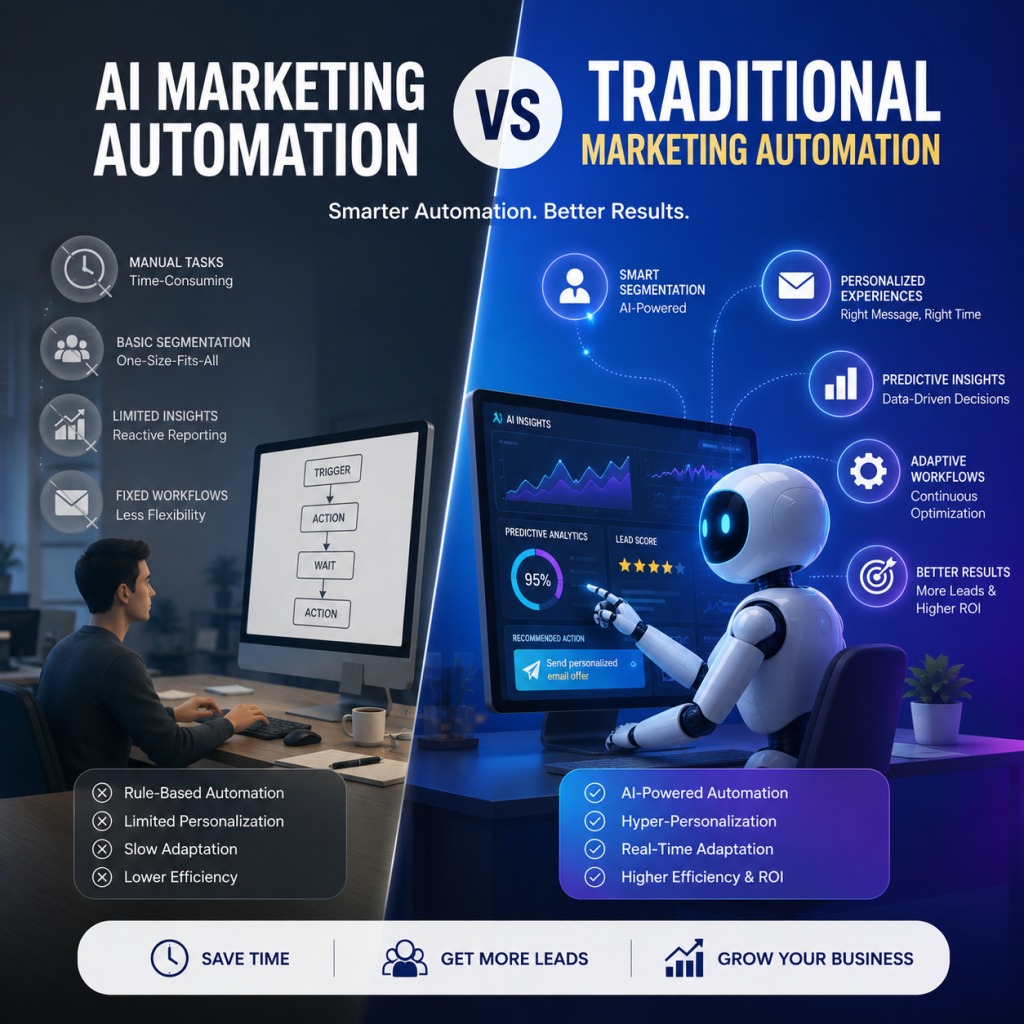
The goal isn’t to completely replace traditional automation.
Instead, AI can make existing automation more intelligent and useful.
Is AI Marketing Automation Worth It?
For many businesses, yes—but only when it is connected to a real business objective.
If your team spends hours every week performing repetitive marketing tasks, automation may help reduce that workload.
If your business receives many leads, AI can help prioritize them.
If you have a large customer base, personalization can help you communicate more effectively at scale.
The key is to start small, measure the results, and expand what works.
The Future of AI in Digital Marketing
AI is likely to continue changing how businesses approach digital marketing.
We can expect greater use of AI in areas such as:
- Personalized customer experiences
- Predictive analytics
- Automated campaign optimization
- Conversational marketing
- Content creation
- Customer journey automation
- Search and content optimization
- Marketing analytics
But the future of marketing won’t simply be AI vs humans.
The strongest approach is likely to be:
AI efficiency + Human creativity + Marketing strategy
AI can process information quickly and automate repetitive activities.
Humans provide:
- Strategy
- Creativity
- Empathy
- Brand understanding
- Critical thinking
- Customer relationships
Together, they can create a stronger marketing system.
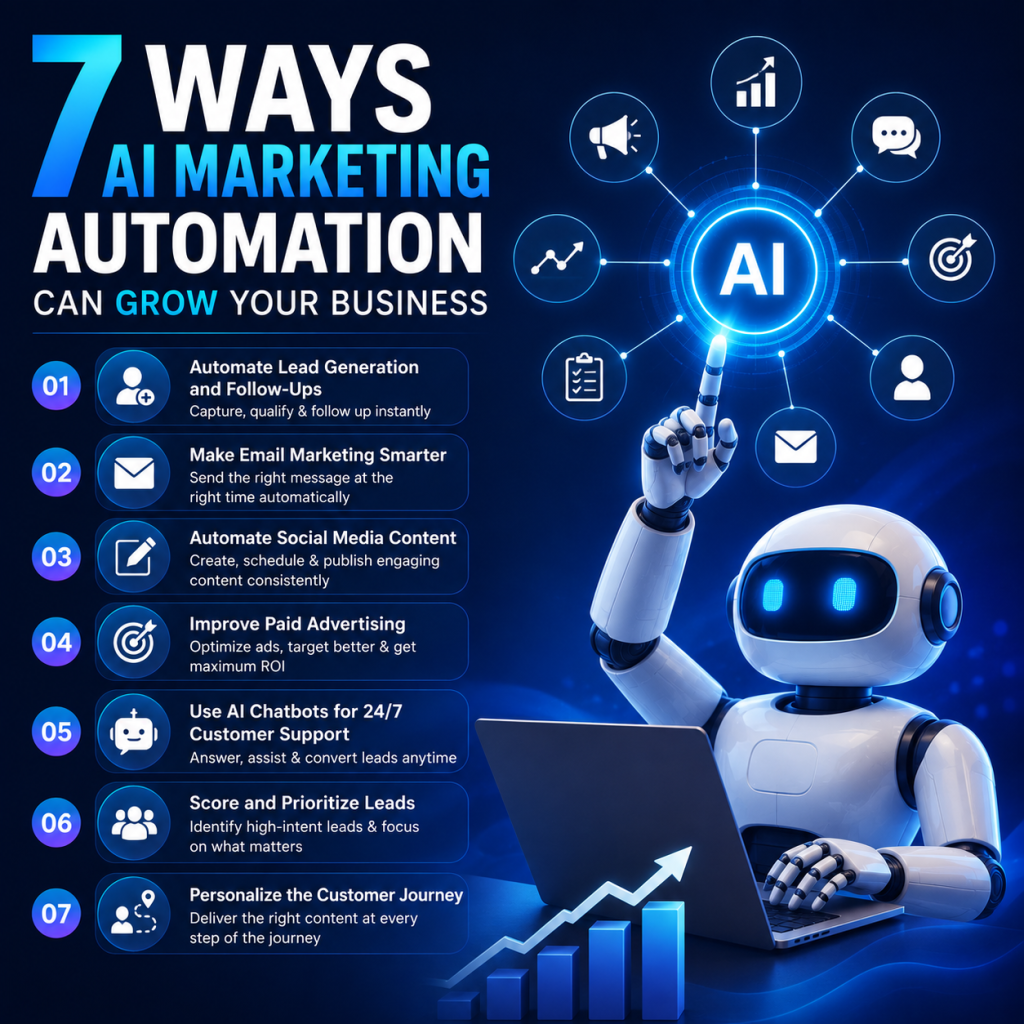
7 Ways AI Marketing Automation Can Grow Your Business
1. Automate Lead Generation and Follow-Ups
One of the biggest advantages of automation is faster lead follow-up.
Suppose someone fills out a form on your website.
Instead of waiting several hours for someone from your team to respond, an automated workflow can immediately:
- Capture the lead
- Store the information
- Send a confirmation message
- Qualify the lead
- Notify the sales team
- Trigger a follow-up sequence
Faster responses can create a better customer experience.
2. Make Email Marketing Smarter
Email marketing can become much more effective when combined with AI and automation.
For example, instead of sending one email to your entire database, you can create different workflows.
Example:
New subscriber
→ Welcome email
→ Educational content
→ Product/service information
→ Case study
→ Offer
The workflow can then respond differently depending on how the customer interacts with the emails.
This saves time while making communication more relevant.
3. Automate Social Media Content
Creating social media content consistently can be challenging.
AI can assist with:
- Content ideas
- Captions
- Content calendars
- Short-form video scripts
- Hashtag research
- Repurposing content
- Post variations
Automation tools can then help schedule content across platforms.
However, don’t let AI completely replace your brand’s personality.
Use AI for speed, but use human creativity for authenticity.
4. Improve Paid Advertising
AI is increasingly being used within advertising platforms to help businesses optimize campaigns.
AI-powered systems can assist with:
- Audience targeting
- Bid optimization
- Creative testing
- Budget allocation
- Conversion optimization
- Performance analysis
For example, instead of manually testing every possible audience and advertisement combination, automation can help identify patterns in campaign performance.
But marketers should still monitor campaigns and make strategic decisions.
5. Use AI Chatbots for 24/7 Customer Support
Imagine a customer visiting your website after business hours.
They want to know:
“What services do you provide?”
An AI chatbot can provide an immediate answer.
It can also help with:
- Frequently asked questions
- Lead qualification
- Product information
- Appointment requests
- Basic customer support
- Lead collection
This doesn’t necessarily mean replacing your customer service team.
Instead, the chatbot can handle repetitive questions while your team focuses on more complex customer needs.
6. Score and Prioritize Leads
Not every lead has the same buying intent.
AI can analyze customer interactions and help businesses identify high-intent prospects.
For example:
Lead A: Visited your homepage once.
Lead B: Visited your pricing page, downloaded a brochure, and submitted an inquiry.
Lead B may be more valuable for immediate sales follow-up.
AI-based lead scoring can help marketing and sales teams prioritize their time.
7. Personalize the Customer Journey
Customers expect relevant experiences.
AI can help businesses understand where customers are in their buying journey and deliver appropriate content.
For example:
Awareness
→ Educational blog
Interest
→ Case study
Consideration
→ Product comparison
Decision
→ Demo or consultation
Retention
→ Follow-up and personalized offers
This creates a more connected customer journey.
Frequently Asked Questions
What is AI marketing automation?
AI marketing automation combines artificial intelligence with marketing automation to automate tasks, analyze customer behavior, personalize communication, and improve marketing campaigns.
How can AI save time in digital marketing?
AI can assist with repetitive activities such as content creation, lead qualification, email workflows, customer support, data analysis, social media planning, and campaign optimization.
Is AI marketing automation suitable for small businesses?
Yes. Small businesses can start with simple use cases such as automated lead follow-ups, email marketing, chatbots, content creation, and customer segmentation.
Does AI replace digital marketers?
No. AI can automate repetitive tasks and assist with analysis and content creation, but strategy, creativity, judgment, and customer relationships still require human involvement.
What is the best AI marketing automation tool?
There is no single best tool for every business. The right solution depends on your marketing goals, budget, team size, existing systems, and required automation.
How should a business start using AI marketing automation?
Start with one repetitive marketing task, define a measurable goal, select an appropriate tool, build a simple workflow, and monitor the results before expanding.
What are the risks of AI marketing automation?
Common risks include inaccurate AI-generated content, poor-quality data, excessive automation, privacy concerns, lack of human review, and irrelevant customer communication.
Can AI help generate more leads?
AI can support lead generation by improving targeting, content creation, personalization, chatbots, lead scoring, and campaign optimization. However, results depend on the overall marketing strategy and execution.